Forbes to Fitzgerald
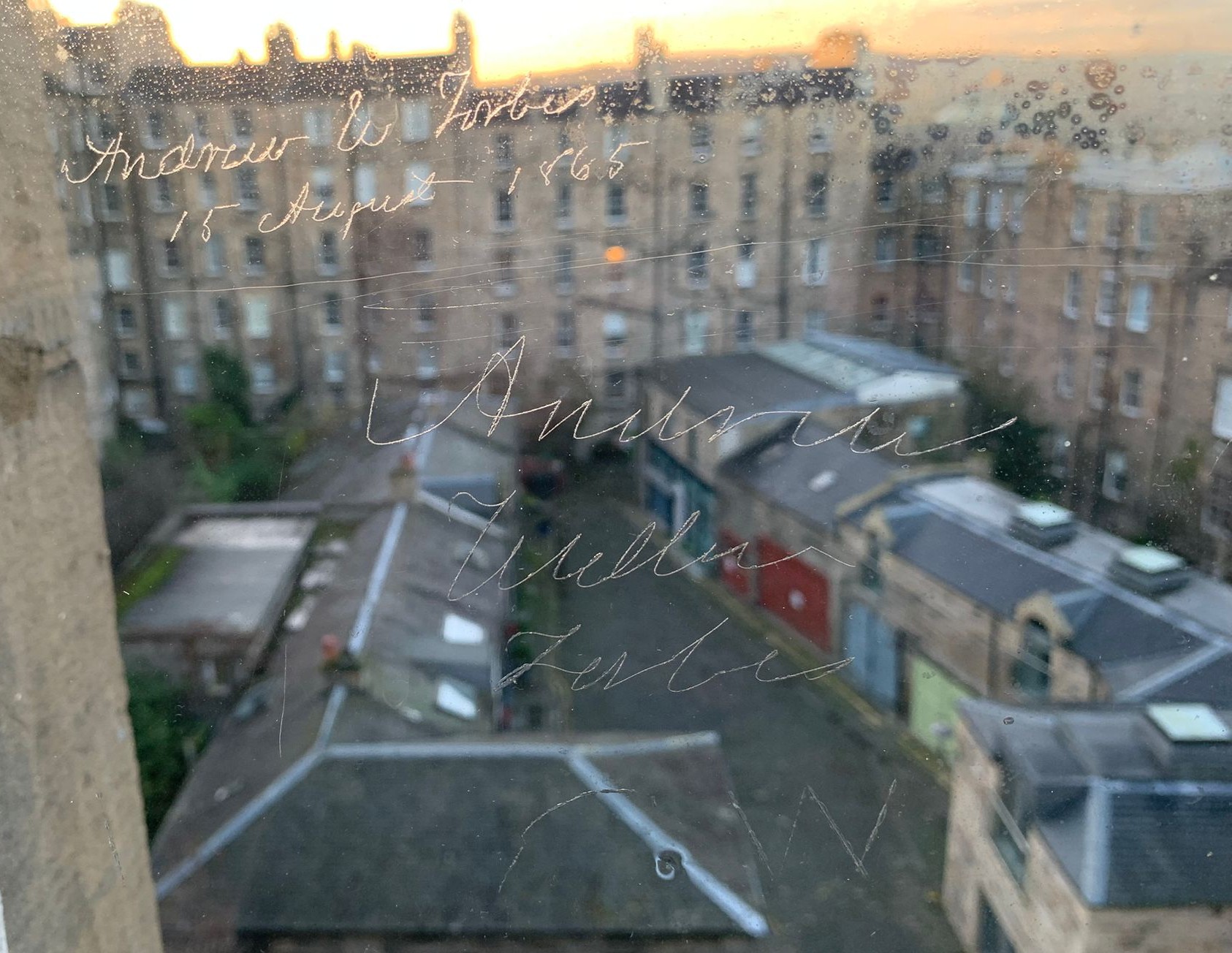
Andrew W Forbes
15 August 1865
Then a scrawled signature: Andrew Wallace Forbes
These words are etched on a window high above 10 Scotland Street, overlooking the lane, which in 1865 was edged with coach houses and stables.
In 1824 William and Alexander Lewis Wallace, a father and son partnership, built numbers 4 to 10 Scotland Street, following the Council’s over-arching plan for the external features – the stonework, the stairways, basement areas and windows. By the time Andrew Forbes etched his name on the hand-made glass, the building was already 40 years old.
Andrew Wallace Forbes, the etcher, was the son of David Andrew Forbes and Helen Wallace.
David Forbes’ parents, Walter Forbes a Glasscutter, sometimes Slabcutter, and Margaret Budge, were married in South Leith Church on 20 October 1800. They made their home at 4 Elder Street – where the Edinburgh Bus Station is now. David was born around 1819 but the record appears to be lost. He had a sister named Margaret and a brother, Walter, who became a Brass Founder.
On 9 June 1840, in St Cuthbert’s Church at the West End of Princes Street, David Andrew Forbes, a glass manufacturer, married Helen Wallace.
Helen’s mother was Ann Adam who was born in the Canongate, on 27 July 1793, to Janet McArra and John Adam, a tinsmith. Her father was Andrew Wallace, who was born in 1798 in Blackburn, Livingston and moved to 6 Haddington Place, Leith Walk, Edinburgh to set up as a sculptor and marble cutter with a yard at Shrub Place. The marriage of Ann Adam and Andrew Wallace took place on 29 April 1818 and is worth quoting in full for its evocation of Edinburgh at the time.
Andrew Wallace, Marble Cutter, Shoemakers close, Canongate. Reid’s lodging, ground floor, and Ann Adam, in said close, lane and Story, daughter of John Adam, Tinsmith, Queen Street, Edin, gave up their names for marriage. Certified by Alexander Smith, Marble Cutter, Shakespear square, Edin and John Smith, Carver & Gilder there.
All in beautiful cursive script. Shakespear Square was at the east end of Princes Street before the Waterloo Bridge was built. There’s a good map – Kincaid’s 1784 – in the National Library at https://maps.nls.uk/view/216390252
In the census of 1851, David and Helen were listed at 10 Dublin Street with their four children and grandmother, Ann Wallace.
David’s parents both died in 1853, Margaret Budge aged 66 on 10 November of Palsy and Walter Forbes, aged 75, on 22 December of Decline of Life. They were taken from their home on St James Square and buried in Warriston Cemetery in Compartment M, Plot 10 at a depth of 10 feet. The registers are very precise.
When the census was taken in 1861, David and his family were listed at 8 Scotland Street. Walter, their first child, was 20 and a medical student. Edinburgh University’s Medical School was still reckoned among the finest in the world, with surgeons such as Robert Liston and James Syme – and Joseph Lister’s introduction of aseptic techniques. Andrew Wallace Forbes, our etcher, was 18 and a Marble Cutter, which might explain the etched window. He would have had access to the tools and perhaps had been apprenticed to his grandfather at Shrubhill. Sister Ann was 16, and Margaret 14. Grandmother Ann Wallace, aged 66, was still with them. Ann Wallace is described on all census forms as a marble dealer’s wife, but seems to have lived with David and Helen for most of their marriage. They had one servant, Margaret Croy, aged 19. Unusually for Scotland Street they were all born in Edinburgh. The last column which lists the number of rooms with at least one window, records nine rooms.
At some point before 1869, when brother Walter qualified as a medical doctor and set up in practice, the family: David, Helen, and their four offspring, all unmarried, along with grandmother, Ann Wallace, moved to 4 West Newington Terrace, on the South Side.
On 8 June 1870, in the Parish Church of St George the Martyr, London, 25-year-old Andrew Wallace Forbes, a sculptor of 4 West Newington Terrace, married 22-year-old Agnes Whitehead Holden of 27 Lamb’s Conduit Street. Their fathers, David Forbes and Archibald Holden, a contractor, signed the register. Were their fathers friends? Brought together by trade? Andrew and Agnes set up home at Shrub Vale House, on Leith Walk, nearby grandfather Andrew Wallace’s yard and next door to Shrub Vale Cottage, and to the Leith Walk Nursery and Bothy in which lived two Gardeners. The nursery was the remnant of the Botanical Gardens which had been moving, bit by bit, to Inverleith, since the 1820s. Andrew and Agnes were looked after by one domestic servant, Joan Fraser.
On 11 February 1873, Andrew’s grandfather, Andrew Wallace, the sculptor of Haddington Place, died and was taken to Rosebank Cemetery on Pilrig Street. The register of Rosebank tells us that he was buried in Compartment L, Plot 8, at a depth of 7 feet. Three months later, on 6 May, Andrew’s grandmother, Ann Wallace died of apoplexy at 4 West Newington Terrace. Her grandson, Walter signed off her death and recorded it – Walter Forbes MD, Grandson. She joined her husband in Compartment L, Plot 8. Her funeral left from her husband’s home at 20 Haddington Place. What was the story of this pair? Was it mere co-incidence that Ann was always visiting her daughter when a census was taken?
On 20 December 1873 Andrew’s sister, Margaret, married Edinburgh-born William Edwin Peck of Cumberland Street. Glasgow. and left the family home at West Newington Terrace.
On 29 June 1876, Dr Walter married Cecilia Purdie Thornton, the daughter of a deceased India Rubber Manufacturer, at Woodville, Stratton Place – a location regarded, then as now, as most desirable. He took her back to 4 West Newington Terrace
That same year, on 19 November, Andrew’s father, David, Glass and China Merchant, now of 5 Torphichen Street, died of inflammation of the membrane lining of the brain, intestate. His daughter Ann signed his death certificate. He was buried in Rosebank Cemetery, Compartment L, Plot 7, 10 feet down, next door to his parents-in-law. His widow, Helen Wallace inherited £533 6/-, a not-inconsiderable sum at the time. She moved to 156 Ferry Road. Fifteen months later, on 6 February 1878, she joined her husband, 10 feet down in Compartment L, Plot7. Her death certificate, signed by Agnes, Andrew’s wife, her daughter in law, gave as cause of death, Disorder of the Stomach and Bowel, Anaemia and Exhaustion. Poor soul.
Ann moved in with brother Walter and Cecilia at 4 West Newington Terrace. However, only two years later, on 5 October 1880, Walter died of disease of the brain, annotated as probably tubercular, aged only 39. His brother, Andrew, registered the death. Walter went off to Rosebank, Compartment L, Plot 8, 8 feet down, next to his parents. He left an estate of £373 8/-.
By 1881, Ann had joined her sister, Margaret, in Glasgow. Cecilia had married again and left Edinburgh with her new husband, Hugh Thomson, and niece, Nellie, to live in Bath for some years. After her husband Hugh’s death, she lived at 24 Cluny Gardens with Nellie who inherited her fortune of £19, 738 16/- when Cecilia died on 23 December 1925 She eschewed Rosebank and Walter and was buried in St Cuthberts beside Hugh.
Back to Andrew, the only one of the four siblings still in Edinburgh. By 1881, Andrew has changed profession to become Assistant to the Burgh Engineer and has moved his family to 9 Bellevue Street, a few minutes’ walk from Scotland Street. He and Agnes have three children – a daughter Helen, aged 9, and sons Archibald, 8 and David, 5. In 1895 they are all still in Bellevue. Archibald is an engineer’s apprentice and David is a painter’s apprentice. Helen has no recorded occupation.
In the 1901 census the family has moved to 35 Lauriston Gardens near the Royal Infirmary. Helen at 29 is a typist/ stenographer and David, aged 24, is a house painter. Archibald is not listed. He is at sea.
On 1 July 1902, at 35 Lauriston Gardens, 37 years after he had etched his name on the window at 8 Scotland Street, Andrew Wallace Forbes died of malignant disease of the pylorus which he had suffered for 8 months. He joined his parents and brother in Rosebank cemetery. He lies six feet down in Compartment L, plot 7. Helen left the South Side for Trinity.
Their older son, Archibald Wallace Forbes, was a marine engineer. His first ship in 1895 was Pembroke and his last, in 1911, was Crescent on which he was counted in the 1911 census, in China and East Indies Region, as a fitter and turner and as a single man. In between he was a crew member on a long list of ships. In 1895 when he joined his first ship, he was 5 feet 5 inches tall, with brown hair, slate eyes and a fresh complexion. His left forearm was tattooed. Twelve years later, he was 5 feet 7.5 inches tall with fair hair, and grey eyes. His character throughout was described as very good. There are several First World War records of Archibald Wallace Forbes, but none I think are he. Perhaps his was destroyed by the Second World War bombing of the archives. He is to be found again in Jamaica where he worked as an Aerial Railway Engineer for the United Trust Company of Jamaica. In doing this he joined many young engineers from Scotland who left the prevailing difficult economic circumstances and crossed the Atlantic in search of work. He sailed back from Kingston on Camito of the Elders and Fyffes Line in time for the 1921 census at Beach House, 31 Trinity Crescent, where he registered himself as single. Beach House is a five-room, two-storey house which appears to be older than its surroundings and is actually on Starbank Road, looking out over the Firth of Forth, and a few short yards east and across the road from the Old Chain Pier Inn. Established in 1821 as a port of call for Merchant Shipping, the Inn has served in a number of guises and is now a popular hostelry.
On 31 December 1921, Archibald left Liverpool for New York on the White Star line ship, Baltic.
On 1 February 1924 he arrived at the Broadway Central Hotel, New York in transit to England from his usual residence in San Domingo, Dominican Republic. He is a 51-year-old engineer and somehow has become a permanent resident of the United States. His significant person is Albert Bass, a friend, of the Consuelo Estate in Macons, RD. Aged 51 he has shrunk to 5 foot 7 inches but he still has his light hair and eyes. He plans to stay at Beach House, 31 Trinity Crescent, Edinburgh, his mother’s home. The Anchor Line ship, Cameronia, delivered him to Liverpool, presumably in time to be with his mother before her death. Agnes Holden Forbes died at Beach House, of senile tuberculosis, on 21 November 1925, twenty-three years after her husband, Andrew. Her funeral took her to Rosebank where she was buried beside Andrew in Compartment L number 8. The depth is not recorded. She was 77.
The next record, that I can find, of Archibald returning to Scotland appears on the passenger manifest of Themistocles, of the Aberdeen Line, which docked in Southampton on January 17 1927, having steamed from Australia via South Africa and Tenerife. Archibald was surely a peripatetic man. He is listed as a civil engineer and intends making his residence in Scotland. However, there is no further evidence that I can find that Archibald ended his days in Scotland. Or indeed, anywhere else.
His younger brother also made his home in America.
In 1904, David Holden Forbes left from Glasgow for New York on Furnessia of the Anchor steamship line. On 17 August 1907, in the Church of the Transformation at 1 East 29th Street, Manhattan, New York, he married Margaret Johnson, a fellow Scot from Selkirk. In the Portland census of 1910, he states that he is working on his own account as a decorator and has been out of work for 6 weeks in the preceding year. He became a citizen of the United States of America on 13 December 1913. On 12 September 1918, when David registered for the First World War draft, the couple were living at 195 Oak Place, Akron Summit, Ohio where David was working for the Halls Rubber Company. I can find no record of him being drafted into the army.
From 1920 they were in Mexico where David was working for the Portland Rubber Company and the Peltzer Tyre and Rubber Company. In 1923 they were back in Portland and on 5 September 1923 David applied for a US passport for himself and his wife. He intended going abroad temporarily to see his mother and returning within one year. On his passport he is described as 45 years old, 5 foot 8 inches tall, with a high forehead, sandy hair, blue eyes and a straight nose.
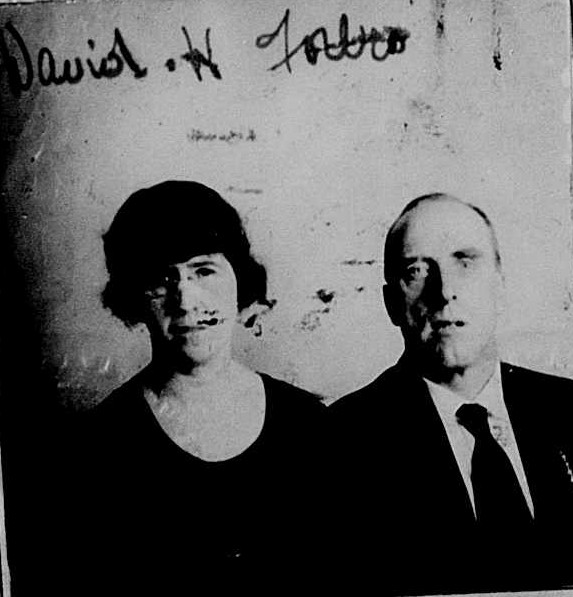
Here he is, Andrew’s son, with his wife Margaret.
They sailed for Britain on Columbus on 5 September 1923 and so presumably met up with his brother and saw his mother before she died, but they returned to the US before the event. In the 1925 State Census he is listed with many others at 501 121 Street West, New York, as a Superintendent in a Rubber Mill.
He must have returned to Britain in the 1930s, as in 1939 he is named in the registration taken for war purposes by the British Government, with a group of other people ranging from journalists to waiters, in a house called Woodside, in Barnet, London. He is listed as a Rubber Technologist.
On 24 January 1940 he sailed from Southampton on Westerland of the Holland America Line, making New York on 3 February. What had he been doing in Britain that led him to cross the Atlantic at such a dangerous time? He was 64 and gave his US address as 682 Forest Avenue, Rye, New York and his UK address as 189 Regent Street, London – an interesting venue which, in its basement, hosted a number of private members’ clubs of dubious repute. In 1942, he was registered for service while living in Chicago and working for the Service Sized Products Company, Rubber Department. And then he and his wife, as far as I can see, disappear. There may be a record of his death somewhere but it is in none of the registers I have searched. A mystery.
And then there is their elder sister, Helen Holden Forbes, born 1881. After her father died, she lived with her mother at Beach House, Ferry Road. plying her trade as a Typist.
She was elusive. No marriages. No deaths at what would seem around the right year in the statutory records.
I looked for her in the Rosebank cemetery registers – and there she was. She was interred beside her father and mother on 29 December 1925 in Compartment L number 7, just one month after her mother. I noted that the day of her death was not recorded. The funeral proceeded from Helensburgh. Which seemed … odd. Then I found her death certificate which was signed by Noel Edwin Peck, Cousin
We need to go back here to Helen’s aunt, Margaret Budge Forbes, Andrew’s younger sister, who was born in Edinburgh in 1846, just seven years before the death of her grandmother, Margaret Budge, for whom she was named.
Margaret Budge Forbes had married William Edwin Peck, and moved to Glasgow. Over twelve years, Margaret gave birth to James Wallace, Noel Edwin, Charles William, Ralf D, Helen Margaret and Guy Alexander Forbes, in various homes on the north west of Glasgow. In 1891 they had moved to Broomhill Farmhouse in Partick. William was a warehouseman. Their eldest son, Noel Edwin Peck was an apprentice shipbuilder.
On Friday 24 September 1897 Margaret’s father-in-law, James Joseph Peck, a naval architect, is – this is the headline – TRYING TO INTERDICT EDINBURGH CORPORATION. They want to stop the Corporation from building on a property at Shrubhill, Leith Walk. Their complaint rests on an ante-nuptial contract between Margaret Forbes and William Edwin Peck. An ante-nuptial is a marriage contract specifying various rights and duties within the marriage. The property at Shrubhill had once belonged to Margaret’s maternal grandfather, Andrew Wallace, the sculptor and marble cutter of 6 Haddington Place, and Shrubhill, Leith Walk, whom we met at the very beginning of this tale. Compensation had been offered by the Corporation but the Pecks, father and son, wanted more. Lord Low, sitting in the Court of Session told them, more or less, to go away and sort it out themselves.
On three occasions William Edwin Peck was admitted to Gartnaval Royal Lunatic Asylum. I looked up the General Registers of Lunatics in Asylums. This involves checking many, many pages of handwritten entries, complicated by the fact that, belatedly, I found that Gartnaval is filed under Glasgow Royal Lunatic Asylum… William was admitted as a private patient on 10 February 1893 and given the number 58.855. He was discharged, “Recovered” on 25 March 1893 – only to be readmitted on 29 November 1893 and discharged, “Recovered” on 29 January 1894. This time he did not relapse until 12 June 1896 to be released finally on 11 September 1896. Margaret cannot have had her troubles to seek.
William was listed with his family and all five children in the census of 1901. By 1908 he has moved to a substantial villa, “Newington” on Southbrae Drive, Jordanhill and in 1911is still there – now a Cotton and Linen Agent and an employer of men. Only two sons remain with him. James is a Public Official at the School Board and Guy is a Draughtsman. On Thursday 31 January 1920, the Scotsman carried the notice of William’s death at 722 Crow Road, Glasgow. Crow Road is a very long street which runs all the way from Jordanhill and the douce end of Great Western Road, all the way to Partick, which is not particularly douce. The Pecks were at the more respectable end. William died intestate and so Margaret had to claim her rights as his widow. He left a reasonable £450 13/5. Margaret stayed on at 722 Crowe Road, living with a companion and a servant, until her death from Influenza in 1929, often visiting her son, Noel Edwin Peck, in Helensburgh. I note that on her death certificate her husband’s profession had been elevated to Linen Merchant.
Noel Edwin Peck, their eldest son and Andrew Wallace Forbes’s nephew, was a Naval Engineer who was a director of the Barclay Curle shipbuilding firm and during the First World War, was Director of Shipbuilding at the National Shipyards. His home was Rockbank Villa in Helensburgh. My Great Uncle lived in one of these villas. They were pretty grand but could be chilly, heated by coal fires. Rockbank was very grand but is now sub-divided and extended beyond recognition. The playwright James Bridie (1888-1951), a leading light in Scottish theatre, who worked with Alfred Hitchcock, lived there in his later years.
Rockbank Villa was in the news in December 1925. The headline in the Edinburgh Evening News reads: STRUGGLED IN SEA. Scots Woman Drowned. Gallant Rescue attempt fails… The report goes on: Helen Holden Forbes, … was the victim of a sensational drowning affair at Cove on Saturday afternoon. The woman was seen to fall into the sea from the jetty opposite Auchengower House. William McVey, who happened to be in the vicinity, at once plunged into the water and made a gallant attempt to rescue the drowning woman. He succeeded in reaching her and grasping hold of her but she struggled so violently that he was unable to retain his grip. … the body was taken by police launch to the mortuary at Roseneath. Roseneath is a little village on the Roseneath Peninsula, twelve minutes by bus round the top of Gare Loch, from Helensburgh and Noel Peck’s home. The report comments that Helen was well-known in the area and goes on: Lately her mother and one of her aunts died, and it was observed that this double loss had deeply affected Miss Forbes. … and apart from these bereavements she is not known to have had any worries. The implication is clear. The drowning was not accidental.
The death was registered as having taken place in Loch Long at Cove on the other side of the peninsula from Roseneath where she had been staying – but her usual address was Beach House, Trinity Edinburgh. The death was not certified. The Informant was Noel E Peck of Rockbank. Helensburgh, Cousin, who presumably had to identify her. The Procurator Fiscal instigated an investigation. The verdict was that Helen died by drowning and no more action was taken. A sad affair. Helen had indeed lost her mother, with whom she lived, one month previously, on 21 November and her aunt Cecilia on the same day. Her brothers were across the Atlantic. Presumably she had had to deal with the obsequies.
Her will was confirmed to Archibald Wallace Forbes her brother. Her remaining aunt, Ann, died single at 2 Saxe Coburg Place, Edinburgh, aged 83 in 1927, and again Noel Edwin Peck, Nephew, signed her off. And that was the end of the Forbes in Edinburgh.
As far as I can see, none of Andrew Wallace Forbes children produced offspring and of his siblings, only his sister Margaret obliged, and so there seem to be no direct descendants who might be interested in Andrew Wallace Forbes’ bid for posterity etched on a high window overlooking the gardens and former coach houses of Scotland Street, Edinburgh.
A footnote. Margaret’s first-born, James Wallace Peck, after University of Glasgow and Christ Church, Oxford, lectured in mathematical physics and then became an Inspector of Schools. A long list of solid managerial and professional appointments followed in London and Scotland. In 1914, he was commissioned into the Royal Field Artillery and served until 1918, reaching the rank of captain. In 1918, he was appointed senior assistant secretary of the Ministry of Food, a post which he held until the Ministry’s disbandment in 1921, when he became Chief Inspector of the Scottish Board of Health. Then he was off to the National Health Insurance Commission and was responsible for organising emergency arrangements for Scotland during the 1926 General Strike. In 1930, he returned to the Scottish Education Department as second secretary and became permanent secretary in 1936. I vaguely remember coming across him in the depths of studying for a Masters in Education. In 1938, he was seconded to the Food (Defence Plans) Department, preparing for food control during the Second World War, and was knighted by King George VI. War declared, he was appointed Chief Divisional Food Controller for Scotland and held the post until his retirement in 1946. Here he is, grandson of David Forbes, the China Salesman and nephew of Andrew.
In 1911, he married Winifred Knox. They had three sons. Winifred Peck was an extremely popular and prolific novelist, many of whose books are set in Edinburgh. I’m reading The Warrilaw Jewel right now. Winifred died in November 1962. William died eighteen months later.
And her niece was Penelope Fitzgerald, one of my favourite authors, who won the Booker prize with Offshore and numerous awards for her astonishing book, The Blue Flower.
Leslie Hills January 2026